Aluminium has quietly become one of the most important materials in outdoor furniture. It is lightweight, it does not rust, and it suits the clean, contemporary lines that sell well in design-led ranges. For high-rotation retail programs it is hard to beat. If you are sourcing aluminium furniture from China, here is what separates a good supplier from a risky one.
The headline: aluminium is forgiving for the customer but demanding to manufacture well. The quality is in the details you cannot see in a photo.
Why aluminium works for retail
Because it is light, aluminium furniture is easy to move, easy to ship and easy for customers to handle, which lowers returns and damage. Because it does not corrode, it performs in coastal and high-humidity markets where steel struggles. And because it can be extruded and cast into almost any profile, it gives designers freedom to create slim, modern silhouettes.
That combination makes aluminium a natural fit for fast-moving ranges that refresh every season without a premium-timber price tag.
What to check before you order
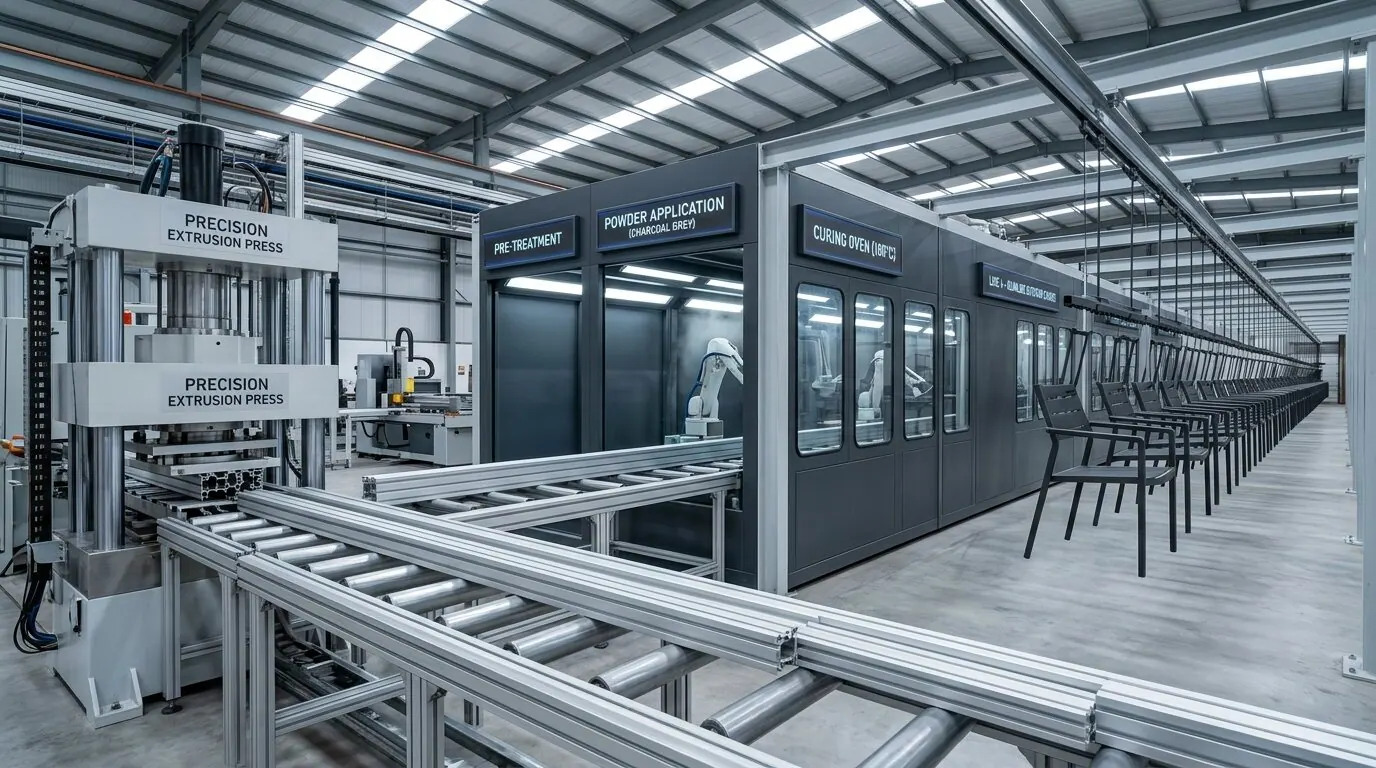
Three things decide quality. First, the alloy and wall thickness: too thin and frames flex, too heavy and you lose the weight advantage. Second, the welds and joins, which should be clean and consistent, as these are the first failure point. Third, the powder coating, which protects the metal and carries the colour. A proper multi-stage pre-treatment and an even, well-cured coat is what stops chipping and fading.
Ask for the pre-treatment process, the coating thickness and how UV stability is tested. A supplier who can answer clearly is a supplier who controls their process.
Cast, extruded or tubular: know what you are buying
Aluminium furniture is not one material but three construction methods. Extruded profiles, pushed through a die into long sections, make the slim, architectural frames that dominate modern ranges; wall thickness is the spec to watch. Cast aluminium, poured into moulds, produces the ornate, solid pieces with a traditional look and a heavier feel. Tubular construction, welded from hollow tube, keeps weight and cost down for volume ranges but depends heavily on weld quality and internal drainage.
Seating surfaces split the category again. Sling furniture, with fabric stretched across the frame, dries fast and suits poolside and contract use. Cushioned aluminium delivers living-room comfort but ties you to fabric and foam choices, which is where quick-dry foam and solution-dyed covers earn their keep.
Matching construction to use case is most of the buying decision. A coastal hotel needs different aluminium than a suburban patio, even if the two chairs look similar in a photo.
How Gardenline manufactures metal
Our aluminium and metal ranges are engineered in China, in facilities suited to the material, with our own team on the ground in Zhejiang handling quality assurance, inspection and shipping consolidation. Dedicated QA teams sign off every order before it ships.
If aluminium is central to your range, request the catalogue and we will walk you through our metal program and finishes.